Across America, millions of older adults live outside the reach of the systems designed to support them. They do not appear in agency records. They do not show up in clinics. They are the most vulnerable, and in many communities, they remain entirely unseen. ILWD finds the older adults our systems do not see and makes them visible for action.
501(c)(3) nonprofit
Open source · Public data · Privacy-first
The systems meant to protect our elders have a blind spot.
Every year, state and local agencies allocate resources based on the people they can see: those who walk through doors, call hotlines, or appear in billing records. But the most at-risk elders are precisely the ones who never make contact.
Invisible to Services
Elders who don't use Medicare, don't visit senior centers, and don't call 211 simply don't exist in the data systems agencies rely on for planning and resource allocation.
Vulnerability is not random. It clusters in specific neighborhoods where poverty, isolation, and lack of services compound. You just need to know where to look.
The information to find these elders already exists in Census records, health surveys, and public datasets. It just has not been connected to the people who need it.
Social determinants reveal what service records cannot.
We analyze the Social Determinants of Health, the conditions where people live, work, and age. Five domains, mapped to micro-areas smaller than a city block, build a picture of elder vulnerability that no single agency could see alone.
Economic Stability
Poverty rates
Employment status
SNAP participation
Housing cost burden
Education Access
Language barriers
Educational attainment
Library proximity
Digital literacy
Healthcare Access
Insurance coverage
Provider proximity
Pharmacy access
Disability rates
Neighborhood
Food access
Transit availability
Housing vacancy
Environmental risk
Social Context
Social isolation
Community organizations
Caregiver burden
Faith communities
Map
An open-source engine for micro-area elder intelligence.
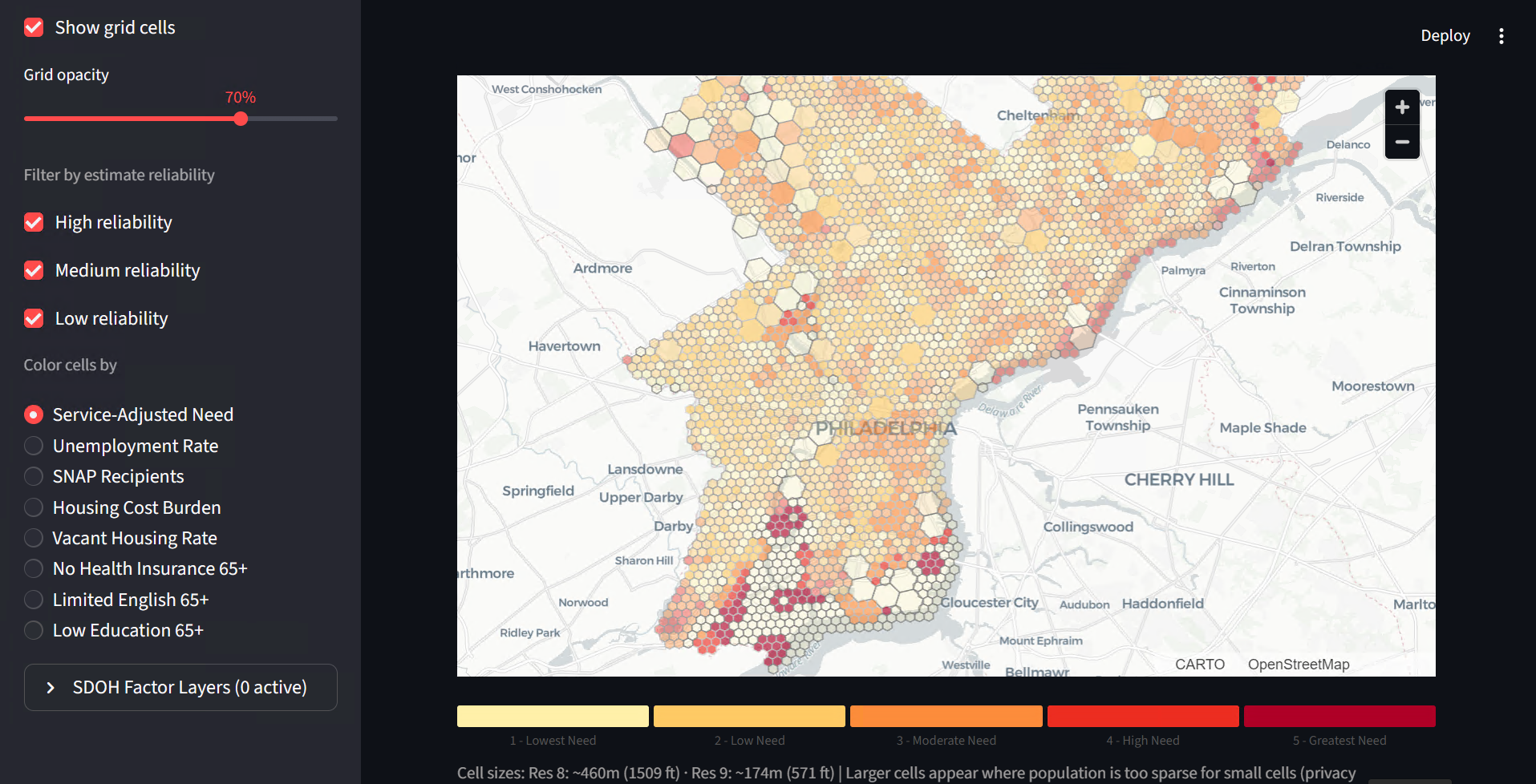
Our analytical platform transforms publicly available data into actionable, street-level insight. Built for agencies and nonprofits. Free to use. Designed to replicate.
A
Micro-Area Precision
H3 hexagonal grid cells as small as 175 meters. Precise enough to guide door-to-door outreach in urban and rural communities alike.
B
26 SDOH Indicators
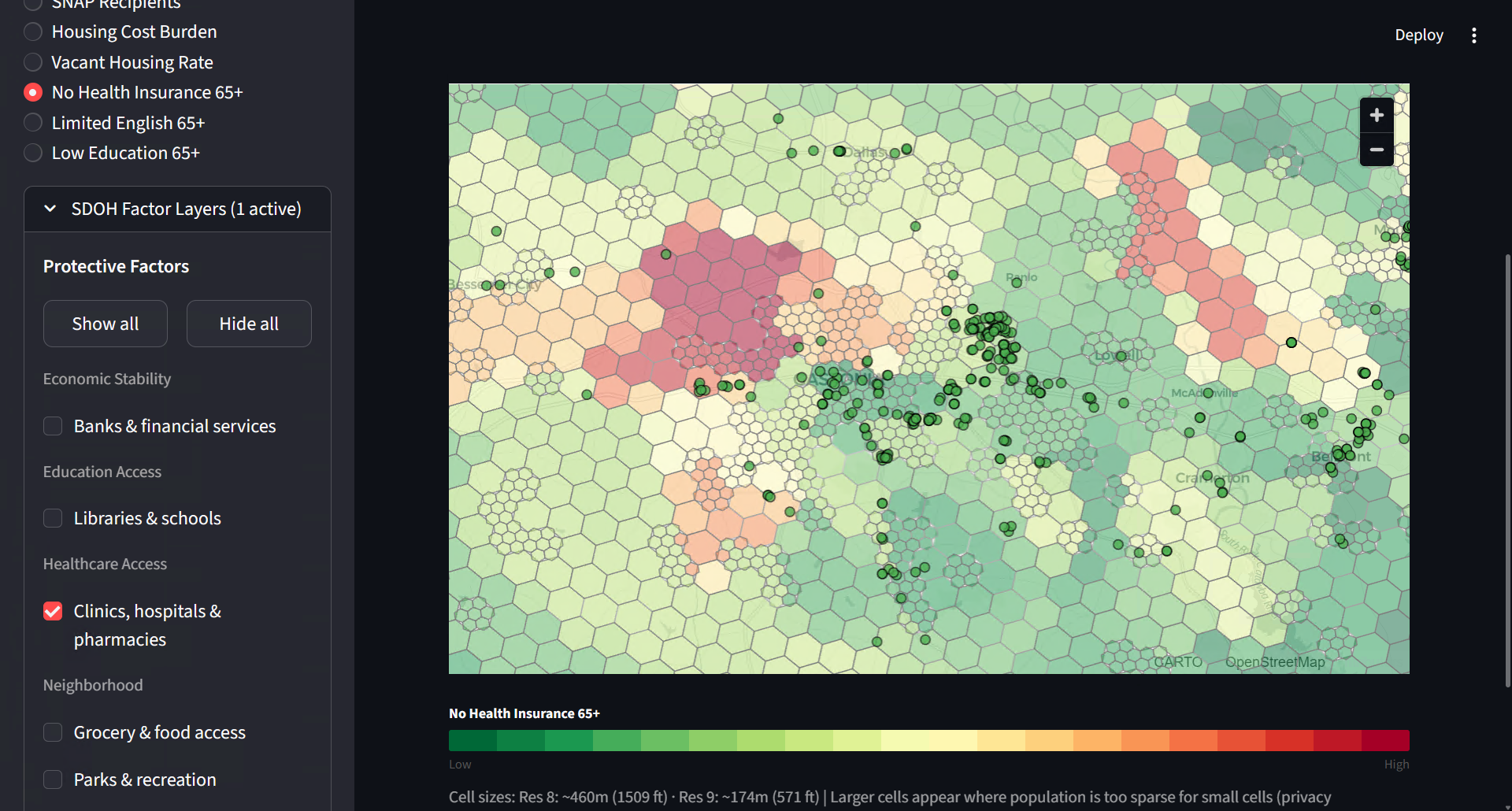
Economic, education, healthcare, neighborhood, and social factors. See what is present in each micro-area and what is critically absent.
C
Service-Adjusted Need
Need scores account for existing services. Areas near resources rank lower. True service deserts rise to the top of every priority list.
D
Open Source and Replicable
Built entirely on public data with no proprietary dependencies. Any community can deploy the full platform for their own region.
Our Process
From raw data to community action.
ILWD follows a structured, replicable process developed through
years of place-based prevention work.
Each phase builds on the last, producing an actionable roadmap tailored to your community.
1
Data Research and Integration
Identify and compile relevant data across target areas. Clean, standardize, and prepare datasets for integrated analysis.
Regional data inventory
Standardized, analysis-ready datasets
Data quality and completeness assessment
2
SDOH Analysis and Opportunity Mapping
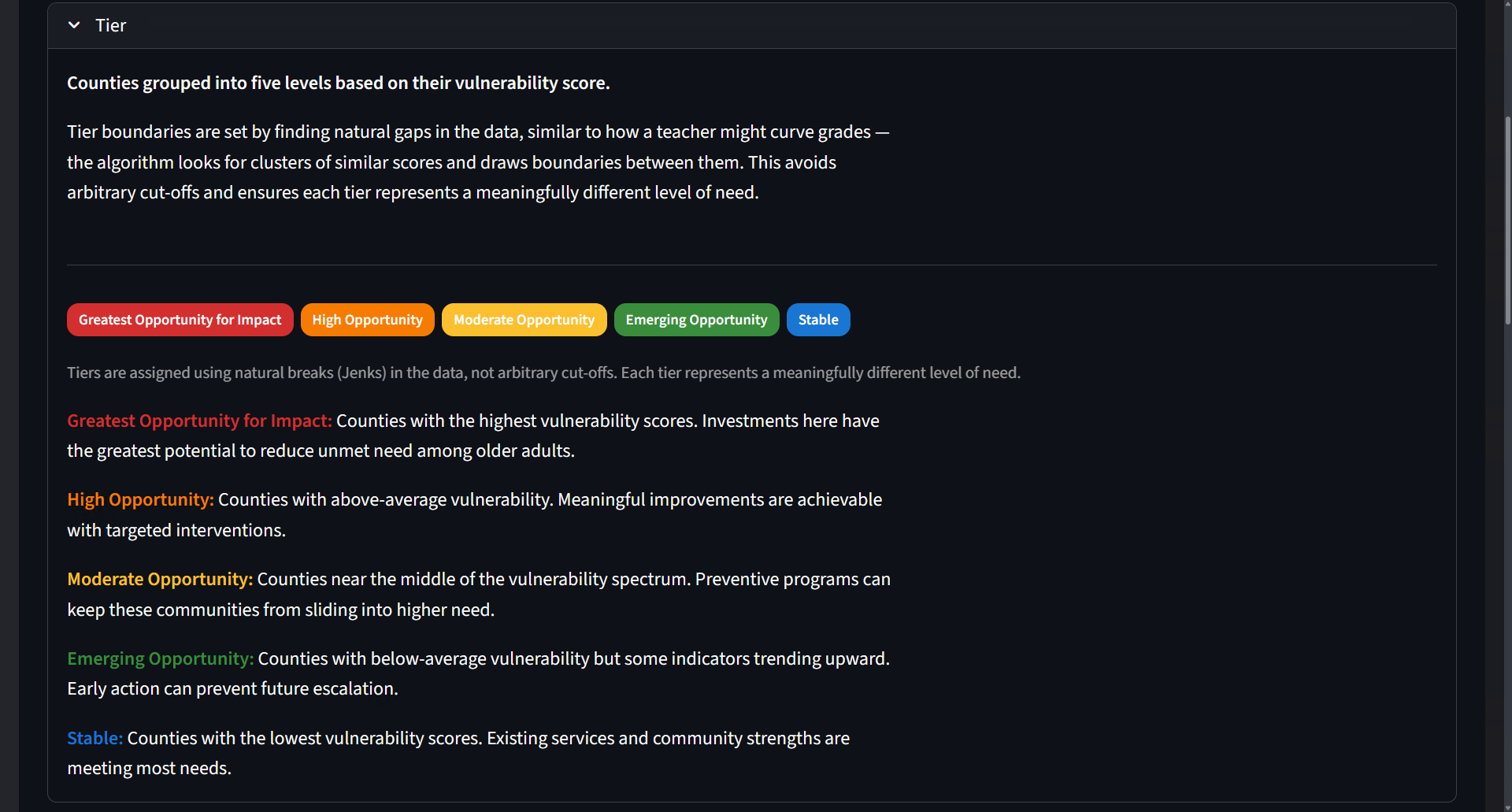
Aggregate and analyze data to generate micro-area opportunity maps across five tiers. Identify service gaps and protective factor patterns.
H3 hex-level risk scores
Five-tier vulnerability maps
Service gap and coverage analysis
3
Community Segmentation
Gather psychographic and demographic data on the 60+ population. Compare highest-need areas to develop targeted engagement strategies.
Audience profiles
Communication strategies
Outreach priorities
4
Action Planning and Alignment
Share findings with stakeholders. Set prevention priorities. Align partners. Build a clear roadmap for positive action.
Community implementation roadmap
Partner-aligned action plans
Performance and accountability benchmarks
Targeted Initiatives
Turning Insight Into Action
ILWD analysis translates data into targeted, place-based action. These examples reflect how communities align programs, services, and outreach with the populations most in need.
A
Health clinic, diabetes management
B
Medicare counseling
C
Adult day program
D
Tax preparation services
E
Bus ads: age-friendly social norm campaign
F
Caregiver support program
G
Senior yoga and balance class
H
Community gardening
I
Falls prevention awareness walk
J
Transit stop: SNAP-authorized market
K
Animal shelter senior volunteer program
Transform
From reactive to proactive. From invisible to protected.
15K+
Micro-areas analyzed across pilot counties
26
SDOH indicators per micro-area
100%
Public data open source tools
"What if we could identify the neighborhoods where elders are most at risk, not after a crisis, but before one ever happens?"
The question that started ILWD
Who This Is For
Built for the organizations closest to the work.
Area Agencies on Aging
Target outreach to micro-areas with the highest unmet need. Align Title III and Older Americans Act resources with data-driven precision.
State and Local Government
Support age-friendly planning, elder abuse prevention, and Medicaid waiver programs with place-based evidence that identifies gaps before they become crises.
Nonprofits and Coalitions
Strengthen grant applications with micro-area need data. Coordinate cross-sector coalitions around shared geographic priorities.
Researchers and Funders
Replicate the methodology in new regions. Study aging equity with granular SDOH data. Fund evidence-based community interventions.
Age-Friendly CommunitiesElder Abuse PreventionCaregiver ProgramsWellness and NutritionMedicare CounselingSenior VolunteeringAdult Day ProgramsFinancial SecurityTransportation AccessSocial Isolation
Bring ILWD to your community.
Whether you serve elders directly, plan services at the state level, or fund aging equity research, our tools and methodology are built for you. Open source. Ready to deploy. Free to replicate.
Improving Lives With Data (ILWD) is a 501(c)(3) nonprofit that has developed a place-based data infrastructure to help communities identify and reach older adults who are not visible within traditional service systems.
Rather than delivering programs directly, ILWD provides the analytical framework, tools, and implementation model that enable government agencies, nonprofits, and community partners to locate unmet need, align resources, and take targeted action.
What ILWD Enables
The ILWD approach integrates publicly available data to generate micro-area insights on risk, service gaps, and community conditions affecting older adults.
This allows partners to:
identify where high-need populations are concentrated
understand which services are missing or misaligned
prioritize outreach and intervention based on real need
In some cases, this leads to better alignment of existing services. In others, it informs the design of new, targeted interventions where gaps are most acute.
The Approach
ILWD combines geospatial analysis, social determinants of health, and population-level insights to produce a structured, replicable model for action.
Partners use this model to translate insight into coordinated action, including:
defining priority populations
aligning cross-sector resources
developing targeted, place-based strategies
Implementation is carried out by local organizations and systems, with ILWD providing the structure and analytical foundation.
Infrastructure, Not a Program
ILWD is designed as an infrastructure initiative, not a direct service provider.
The platform, methodology, and tools are built for institutional adoption, allowing communities to integrate this approach into existing systems and sustain it over time.
This model supports both better alignment of existing resources and the development of new interventions where needed.
ILWD helps communities align what exists and design what’s missing.
Social Determinants of Health
Social Determinants of Health (SDOH) are the conditions in the environments where people are born, live, learn, work, play, worship, and age. These conditions affect a wide range of health, functioning, and quality-of-life outcomes.
We analyze 26 indicators across five SDOH domains, mapped to micro-areas smaller than a city block. This approach reveals patterns of elder vulnerability that no single agency or dataset could identify alone.
Why SDOH for Elders?
Traditional elder service planning relies on who walks through the door. SDOH analysis reveals the conditions that prevent elders from accessing services in the first place: transportation barriers, food deserts, social isolation, language barriers, and economic instability. By mapping these conditions geospatially, we can identify where unmet need concentrates before it becomes a crisis.
Neighborhood and Built Environment: Food access, transit, vacancy, environmental risk
Social and Community Context: Isolation, community organizations, caregiver burden
Why Elders Become Invisible
The most vulnerable older adults are often the least visible to the systems designed to help them. This is not a personal failing. It is a structural one.
The Visibility Gap
Service systems count the people they serve. But the elders who most need help are often the ones who never make contact: those without transportation to reach a senior center, without internet to find resources, without family to advocate for them, or without the health to leave their homes.
Compounding Factors
Geographic isolation: Rural elders may live miles from any service provider
Digital exclusion: Online resource directories do not reach those without internet access
Cultural barriers: Language, trust, and cultural norms can prevent help-seeking behavior
Pride and independence: Many elders resist identifying as "in need"
System fragmentation: No single agency sees the whole picture
Our Response
Instead of waiting for elders to seek help, we identify where they are likely to be. We use the environmental and social conditions that correlate with vulnerability, mapped to specific neighborhoods and micro-areas, to guide proactive outreach.
The Geography of Elder Risk
Vulnerability is not spread evenly. It concentrates in specific places where multiple risk factors overlap, and where protective factors are absent.
Place-Based Analysis
We use H3 hexagonal grid cells, micro-areas as small as 175 meters across, to map the intersection of demographic risk, service access, and environmental factors. This precision reveals patterns invisible at the county or ZIP code level.
What Concentrates Risk
High poverty intersecting with healthcare deserts
Food deserts overlapping with high elder populations
Housing instability in areas with few community organizations
Prior Work
Our methodology builds on proven place-based prevention approaches, including geospatial machine learning work in child maltreatment prevention. That work demonstrated that 60% of adverse outcomes can be predicted within 15% of a city's geography. The same spatial concentration principle applies to elder vulnerability.
Our Data Approach
We build entirely on publicly available data. No proprietary sources, no personally identifiable information, no surveillance.
Data Sources
American Community Survey (ACS): Demographics, income, housing, disability at block group level
CDC PLACES: Tract-level health indicators across 39 measures
Overture Maps: Points of interest including healthcare, grocery, transit, and community organizations
NLCD Land Cover: Satellite-derived land use classification for inhabitable area identification
Microsoft Building Footprints: Building density for population distribution modeling
Privacy by Design
We use a service-gap geography framework. Every output describes areas where services are lacking, never individuals who are vulnerable. Privacy thresholds ensure no micro-area with fewer than 11 estimated persons is ever displayed.
Anti-Surveillance Commitment
The system helps agencies plan better. It does not identify or track individuals. All language, outputs, and reports use service-gap framing: "this area lacks elder service coverage" rather than "X people in need live here." This distinction is fundamental to our design.
Technology and Replication
ILWD is open source and designed for replication. Any community with basic technical capacity can deploy the full analytical platform for their own region.
Technical Stack
Python: Core analytical engine
H3 Hexagonal Grid: Uber's spatial indexing system for micro-area precision
LightGBM: Machine learning for risk modeling with explainability
Monte Carlo Simulation: Uncertainty quantification with confidence intervals
DVC Pipeline: Reproducible data processing from raw sources to final output
Streamlit: Interactive dashboard for exploration and outreach planning
Governance Integration
We provide governance alignment structures, referral system redesign pathways, phased adoption criteria, performance measurement standards, and funding alignment considerations. Everything an agency needs to move from analysis to action.
Implementation Model
Designed for institutional embedding within partner organizations and community systems. ILWD becomes part of how an organization plans, allocates, and measures. It is not a separate initiative to maintain. It is infrastructure.
Our History
Proven Analytical Foundation
This work builds on prior experience applying place-based analysis to complex, real-world challenges. By combining geospatial data with geographic risk factors, it becomes possible to identify vulnerable populations before crises occur.
These approaches help move from fragmented data to actionable insight, supporting earlier intervention and more targeted resource alignment.
Key Insight
Across different populations, one pattern holds: vulnerability clusters geographically, and the underlying risk factors can be measured. Despite this, older adults have often been overlooked in this type of analysis.
Purpose-Built for Aging Populations
This model was independently developed to address that gap, using a refined approach tailored specifically to the aging population and the unique ways risk presents later in life.
Our Four-Phase Process
We follow a structured, replicable methodology developed through years of place-based prevention work. Each phase builds on the last, producing outputs that feed directly into the next stage.
Phase 1: Data Research and Acquisition
We study the data landscape in your target area. Which Census geographies are available? What health surveys cover the region? Where are the gaps? We select, acquire, clean, and prepare datasets that support SDOH analysis at the finest available grain.
Regional data inventory and quality assessment
Source selection across five SDOH domains
Data cleaning, standardization, and spatial alignment
Phase 2: SDOH Analysis and Risk Mapping
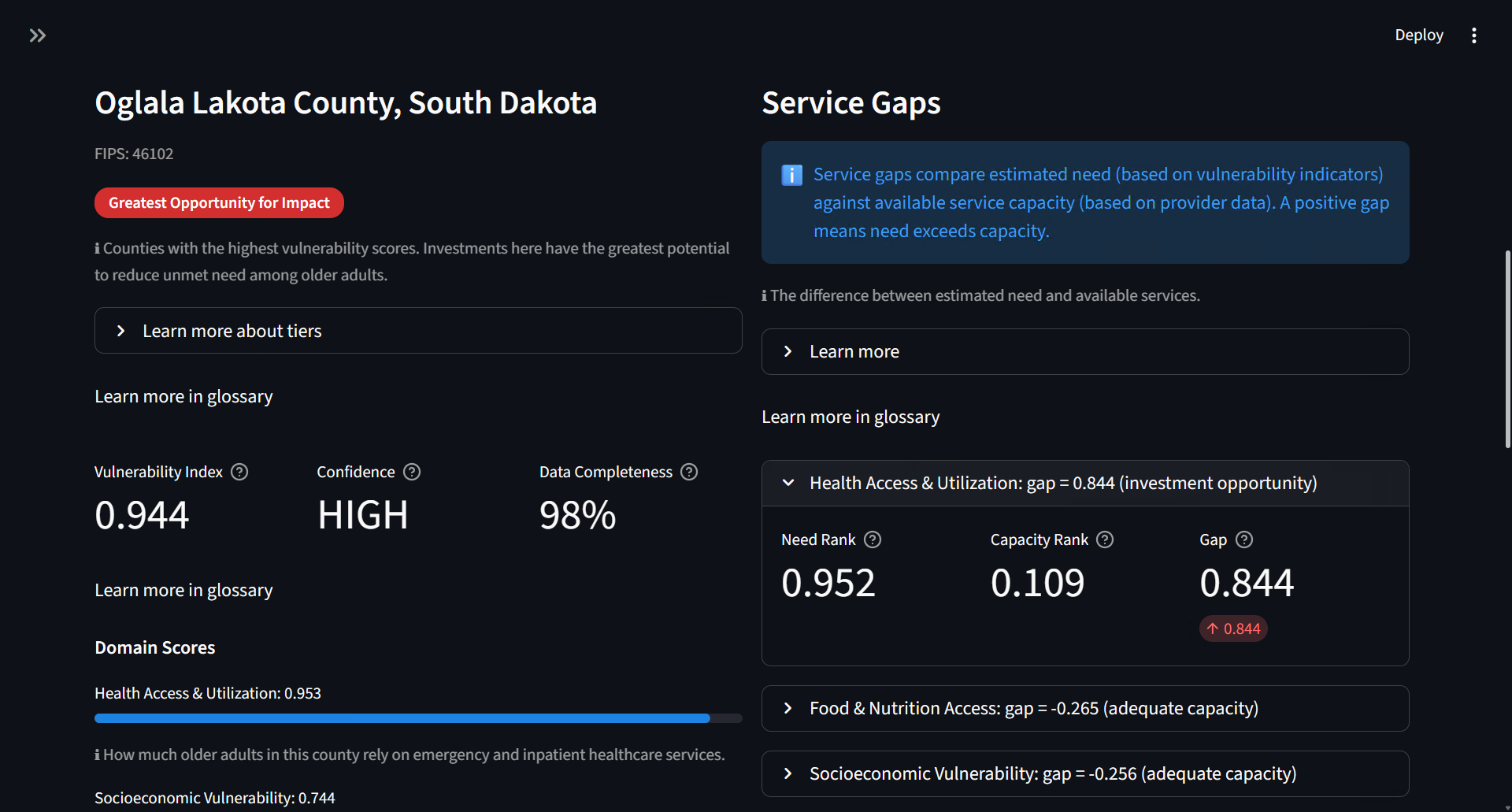
We ingest, aggregate, and transform data into micro-area risk scores. Each H3 hex cell receives a composite vulnerability score built from 26 indicators. Five risk tiers emerge, revealing where need is highest and where services are most absent.
H3 hex-level composite risk scores
Five-tier vulnerability classification maps
Service gap analysis with protective factor overlays
Phase 3: Community Segmentation
We gather psychographic and demographic data on the 60+ population in the highest-need areas. This phase identifies which engagement and communication strategies will resonate with different segments of the elder population.
Audience profiles by psychographic cluster
Targeted communication and engagement strategies
Outreach priority rankings by micro-area
Phase 4: Delivery and Implementation
We present findings, establish prevention goals, and provide a roadmap for aligning existing resources with identified needs. This phase connects analysis to action through partner-specific implementation plans.
Implementation roadmap with phased milestones
Partner-specific action plans
Performance benchmarks and measurement framework
Privacy Policy
Last updated: April 2026
Improving Lives With Data (ILWD) is a 501(c)(3) nonprofit. Privacy is foundational to how we design our platform and how we treat the small amount of information we collect from visitors and partners.
What We Do Not Collect
ILWD’s analytical platform is built entirely on publicly available, aggregated data. We do not collect, store, purchase, or analyze information about individual older adults. We do not maintain lists of people. We do not track households. Our outputs describe geographic areas where services are lacking, never individuals who are vulnerable.
Information We Do Collect
Partner contact information: If you request access to our dashboard or contact us about a partnership, we collect the name, email, organization, and role you choose to share.
Basic site analytics: Standard, privacy-respecting web analytics (page views, referrers, approximate region) to understand which of our materials are useful. We do not use advertising trackers or sell visitor data.
Communications: Any messages you send us via email or contact forms, retained only as long as needed to respond and coordinate.
How We Use Information
Partner information is used to provision dashboard access, coordinate deployments, and send occasional updates relevant to your work with ILWD. We do not share, rent, or sell partner information to any third party.
Micro-Area Privacy Thresholds
Although our platform uses only aggregated public data, we apply additional privacy thresholds on top of source protections. No micro-area containing fewer than 11 estimated older adults is ever displayed at its finest grain. We favor service-gap framing (“this area lacks elder service coverage”) over need-framing (“X vulnerable people live here”) in every output, report, and visualization.
Anti-Surveillance Commitment
ILWD exists to help agencies plan better services. It is not a surveillance tool, and we will not build, sell, or license it as one. We will not accept funding, partnerships, or data contributions whose intended use is to identify, target, or track individuals.
Data Security
Partner credentials and correspondence are stored with standard access controls and encryption in transit. Analytical outputs served from this site are derived exclusively from public data and contain no personally identifiable information.
Your Choices
You may request correction or deletion of any partner information you have shared with us by emailing the address on our Contact page. Because we hold very little personal data, most requests can be handled quickly.
Changes to This Policy
If we make material changes to this policy, we will update the date above and, where appropriate, notify active partners directly.
Contact
Questions about privacy can be directed to the ILWD team through the Partner With Us link on this site.
Terms of Use
Last updated: April 2026
These Terms of Use govern your use of the ILWD website, dashboard, and related materials (together, the “Platform”). By accessing the Platform you agree to these terms. If you do not agree, please do not use the Platform.
About ILWD
Improving Lives With Data is a 501(c)(3) nonprofit. The Platform is offered as a free public resource to agencies, nonprofits, researchers, and funders working on behalf of older adults.
Permitted Use
Use the Platform to understand service gaps, plan outreach, and support evidence-based programs for older adults.
Cite ILWD as the source when publishing analysis or materials derived from the Platform.
Replicate and adapt the open-source methodology for your own region, subject to the project’s open-source license.
Prohibited Use
Using the Platform or its outputs to identify, target, profile, or surveil individual older adults or households.
Re-selling, sub-licensing, or commercializing access to ILWD outputs in ways that restrict public benefit.
Combining ILWD outputs with other data sources in an attempt to re-identify individuals within any micro-area.
Representing ILWD analysis as official government guidance or clinical advice.
Open Source and Attribution
The ILWD codebase and methodology are open source. Underlying datasets are public and subject to the licenses and use restrictions of their original providers (U.S. Census Bureau, CDC, Overture Maps, and others). Users are responsible for complying with those source licenses.
Accuracy and Fitness for Purpose
ILWD outputs are modeled estimates built from public data. They are intended to support planning and prioritization, not to be treated as a census of need or a substitute for direct community engagement. The Platform is provided “as is” without warranties of accuracy, completeness, or fitness for a particular purpose. ILWD is not liable for decisions made solely on the basis of Platform outputs.
No Individual-Level Advice
Nothing on the Platform constitutes medical, legal, financial, or social-work advice regarding any specific person. Agencies and providers must apply their own professional judgment when serving individuals.
Partner Accounts
If you are granted access to the partner dashboard, you agree to keep your credentials confidential, to use the dashboard consistent with these Terms, and to notify ILWD promptly if you believe access has been compromised or is being misused.
Changes to These Terms
We may update these Terms as the Platform evolves. Continued use after changes are posted constitutes acceptance. Material changes will be reflected in the date above.
Contact
Questions about these Terms can be directed to the ILWD team through the Partner With Us link on this site.